All animals → Common Earthworm
Common Earthworm
Lumbricus terrestris · medium
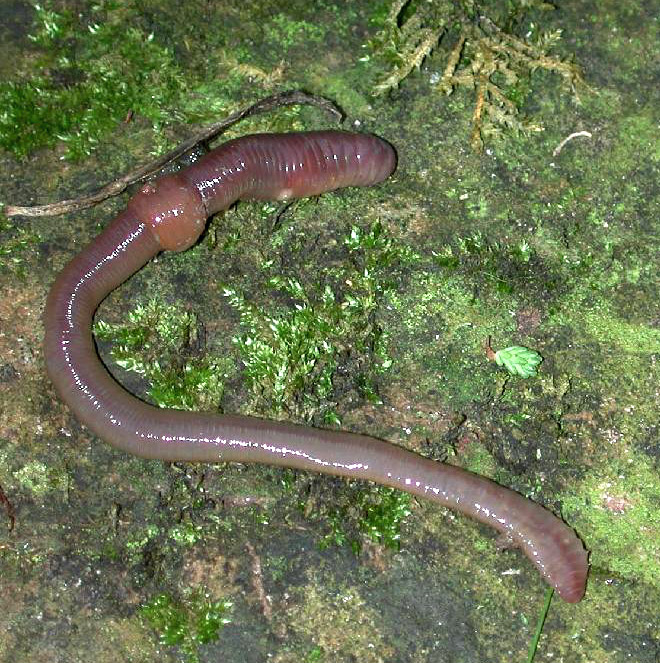
Charles Darwin spent much of the last years of his life studying earthworms, and his final book was about them. He measured how much soil they moved, buried stones to see how fast their casts covered them, and concluded that the fertile layer of the ground had passed through worms many times over. It remains a fair description of what they do.
The common earthworm is a deep burrower. It makes permanent vertical tunnels, sometimes going down more than a metre, and comes to the surface at night to pull leaves down into them — which is where the alternative name nightcrawler comes from. Those burrows aerate the soil, channel water, and mix organic material downward.
It is hermaphroditic but not self-fertilising: two worms exchange sperm, and each later forms a cocoon around the eggs.
It is native to Europe and has been carried almost everywhere by agriculture. In parts of North America that is a problem rather than a benefit. Northern forests there developed after glaciation without any earthworms at all, and their plants depend on a thick undecomposed leaf layer. Introduced worms consume it, changing the soil and the understorey plants that grow in it.
Where it lives
Worml lists the common earthworm as native to 10 countries — France, Germany, Ireland, Italy, Netherlands, Norway, Poland, Spain, Sweden and United Kingdom. Its habitat is moist soil, pasture and deciduous woodland.
Ranges here are reduced to whole countries for playability and exclude introduced populations — see about the data for what that simplification leaves out.
In the game
Common Earthworm is rated medium and appears on Worm Wednesday. To solve the round you need to find any 5 of its 10 listed countries. How scoring works →
Play Worml · Animal index · How to play · About the data · Privacy · Terms
Species ranges are simplified for gameplay and are not conservation data. Photographs are from Wikimedia Commons and credited to their photographers.