All animals → Kākāpō
Kākāpō
Strigops habroptilus · hard
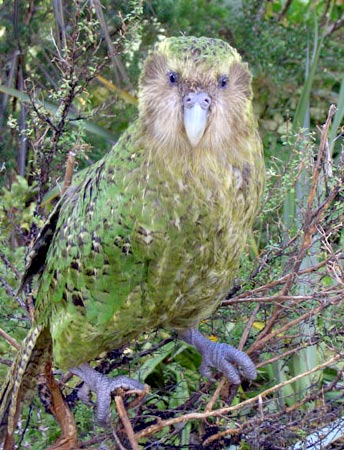
The kākāpō is a parrot that gave up flight, took up a nocturnal ground-dwelling life, and grew heavy — up to four kilograms, making it the world's largest parrot. On an island with no mammalian predators this was a reasonable strategy. Its defence when threatened is to freeze and rely on moss-green camouflage, which works well against a hawk hunting by sight and not at all against a stoat hunting by smell.
Breeding is equally unusual. Kākāpō are the only parrots with a lek mating system: males dig bowl-shaped depressions, inflate a thoracic air sac, and boom a deep resonant note for hours through the night, repeated for weeks. The sound carries kilometres. Females travel to the calls, choose, and raise the chicks alone.
They also breed only in years when certain native trees mast, producing a heavy fruit crop — which may be every few years, and which conservation staff now try to anticipate.
The species came within a handful of birds of extinction. Every surviving kākāpō lives on predator-free islands, is individually named, and is monitored with transmitters, supplementary feeding and genetic management. The recovery is real but painstaking, measured in individual chicks rather than percentages.
Where it lives
Worml lists the kākāpō as native to New Zealand. Its habitat is predator-free offshore islands.
Ranges here are reduced to whole countries for playability and exclude introduced populations — see about the data for what that simplification leaves out.
In the game
Kākāpō is rated hard. To solve the round you need to name the single country it lives in. How scoring works →
Play Worml · Animal index · How to play · About the data · Privacy · Terms
Species ranges are simplified for gameplay and are not conservation data. Photographs are from Wikimedia Commons and credited to their photographers.