All animals → Saola
Saola
Pseudoryx nghetinhensis · impossible
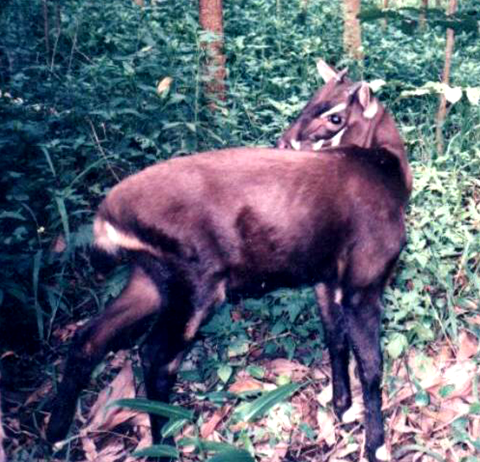
The saola was found in 1992, in the Annamite Mountains on the border between Vietnam and Laos, when survey teams noticed unfamiliar long straight horns in a hunter's home. Finding a large mammal entirely new to science at the end of the twentieth century was startling enough that it became one of the more celebrated zoological discoveries of the era.
It is a bovid, related to cattle and antelope but distinct enough to warrant its own genus. Both sexes carry the parallel horns that give the animal its nickname, the Asian unicorn — in profile the two align into one. It also has unusually large facial glands, which it opens with a flap of skin to mark territory.
Almost everything else about it is unknown. No biologist has reliably observed a saola in the wild. The handful of animals brought into captivity did not survive long. The evidence base is camera-trap images, a small number of specimens, and local reports — the last confirmed photograph was taken over a decade ago.
The threat is not habitat loss so much as snaring: dense lines of wire traps set indiscriminately through Annamite forest. Whether any saola remain is a question conservationists are still trying to answer.
Where it lives
Worml lists the saola as native to 2 countries — Laos and Vietnam. Its habitat is wet evergreen forest of the annamite range.
Ranges here are reduced to whole countries for playability and exclude introduced populations — see about the data for what that simplification leaves out.
In the game
Saola is rated impossible. To solve the round you need to find any 1 of its 2 listed countries. How scoring works →
Play Worml · Animal index · How to play · About the data · Privacy · Terms
Species ranges are simplified for gameplay and are not conservation data. Photographs are from Wikimedia Commons and credited to their photographers.