All animals → Velvet Worm
Velvet Worm
Onychophora · hard
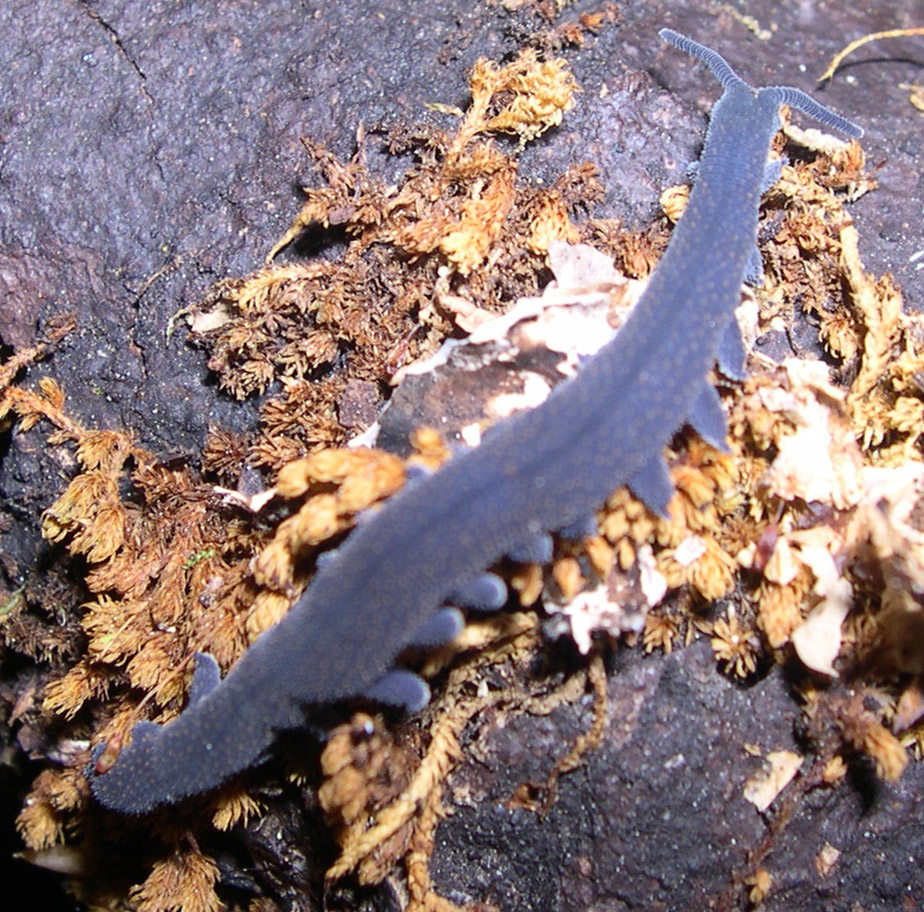
Velvet worms hunt by shooting glue. Two nozzles either side of the head fire jets of a protein slime that oscillate as they travel, laying it down in a net over the prey, where it sets within seconds. The animal then bites through the entangled insect, injects saliva to digest it, and drinks the result — and eats the used slime as well, since producing it is expensive.
Despite the name they are not worms. Onychophora is a phylum of its own, sitting near the ancestry of arthropods, with a body that is soft and unsegmented externally but walks on many stubby fluid-filled legs tipped with claws. They move by changing internal pressure rather than by flexing a skeleton.
The lineage is around half a billion years old and remarkably little changed, which is why they turn up so often in discussions of early animal evolution.
Most species require constant humidity — they lose water quickly and live in rotting logs and leaf litter in humid forest, emerging mainly at night or after rain. Some give birth to live young, and in several species mothers nourish developing embryos internally, which is unusual for an invertebrate.
Where it lives
Worml lists the velvet worm as native to 8 countries — Australia, Brazil, Colombia, Costa Rica, Malaysia, New Zealand, Panama and South Africa. Its habitat is leaf litter and rotting wood in humid forest.
Ranges here are reduced to whole countries for playability and exclude introduced populations — see about the data for what that simplification leaves out.
In the game
Velvet Worm is rated hard and appears on Worm Wednesday. To solve the round you need to find any 4 of its 8 listed countries. How scoring works →
Play Worml · Animal index · How to play · About the data · Privacy · Terms
Species ranges are simplified for gameplay and are not conservation data. Photographs are from Wikimedia Commons and credited to their photographers.